I Sat!
Larry Weishuhn
“This love-hate relationship I have with black bears is at the moment seriously leaning toward the “hate” side of things. They were coming to bait regularly up until two days before you got here, every afternoon right after sundown but before dark. One was an extremely heavy bear. Its belly almost dragsthe ground. I showed a picture of it to the local bear biologist. He thinks it could weigh 400-pounds. It’s black as a moonless night.”
“The other one that’s been coming to that particular bait is a big-framed boar. He’s long and lanky. Pretty sure it’s an older boar that probably weighs somewhere around 325-pounds. He’s mostly black, has a 6-inch strip of much lighter colored hair that starts right behind his ears and ends at his tail. He a really pretty bear. Unfortunately, we don’t have good trail pictures of him.” Said Dusty Vickrey, hunt manager on the Choctaw Hunting Lodge, owned by the Choctaw Nation.
Dusty shoved his phone my direction to show me a picture of the heavy bear. I looked at it closely. The bear indeed was heavy and looked somewhat “squatty”. I scrolled to another photo of the bear where I could see its entire body down to its feet as well as its head. “Dusty, I may be wrong, but to me this one looks like an ancient sow. Look how narrow the head is compared to the body. Look at the ankles. Older mature boars usually have ankles that are big and massive. The ankles on this bear look thin, feminine like.” I hesitated as I looked at another trail camera photo. “I may be wrong. But it surely looks like an ancient sow that is probably past her reproductive years and now is simply putting on weight. She indeed does look like she could weigh 400, maybe even more! Big bear! It also looks like she has a great pelt.” Dusty nodded. “You know my deal, if I shoot a bear on the Choctaw it’s going to Double Nickle Taxidermy (www.doublenickletaxidermy.com) for a life-size mount done for the Lodge.” Dusty smiled.
It had been raining when I arrived at the Choctaw, badly needed rainfall. The entirety of southeastern Oklahoma was in a severe drought and the rain was more than welcome. After donning raingear, under the cover of the roof over the skinning area I prepared to shoot my TenPoint crossbow at 20-yards. Oklahoma’s black bear archery season had opened the day before, October 1. “I’ve shot your crossbow several times. It should be dead-on at 20-yards. I’d suggest you shoot at different bullseyes if you shoot more than once because if you shoot at the same one, you will likely “Robin Hood” the bolts.” I shot at three different spots on the target. Dusty was right, had I shot at the same bullseye with each of the three bolts, I would certainly have ruined all three.
That first afternoon’s sit started at 12:30. As soon as I got into the blind, after setting up tripods for my crossbow and cameras I sprayed down with Wraith (www.wraithhunting.com) to essentially do away with any “odors” wildlife might consider offensive. Throughout the afternoon’s sit I often had deer; does and mature bucks directly downwind of me, some less than 10 feet away. Wraith did away with my human odors and also controlled my thermal image. Deer, squirrels, Eastern turkeys were at the bear bait and all around me throughout afternoon until it was so dark I could no longer even see shapes.
I was hunting during the waning moon, and the first three days of the new moon. Once it was truly dark, Dusty’s guides picked me up for the 8-mile drive back to the lodge for one of Nacolh Vickrey’s fabulous meals. Just as I sat down to eat, Dusty handed me his phone which was receiving trail camera photos. The sagging belly bear was on the bait where I had been sitting.
I had learned other hunters in camp had that afternoon taken a couple of really nice free-range whitetail bucks, scoring in the 160’s! I listened to their stories, masterfully told!
As was always the case, it did not take long to spend a night in this hunting camp. Never does!
Morning after a quick cup of coffee, I was back in my bear stand long before first light. There I spent the day, a total of 15-hours. I was rewarded by seeing several really nice whitetail bucks, several does, squirrels, two different flocks of long-bearded gobblers, but no bear.
The following day was a repeat of the previous 15-hour day. I know most places you hunt black bears only during the afternoon. Mornings are usually spent sleeping or being involved with some other outdoor endeavors. On the Choctaw, it’s not uncommon for bears to come to bait all hours of the day…and at night. It’s important, if possible, to hunt all day.
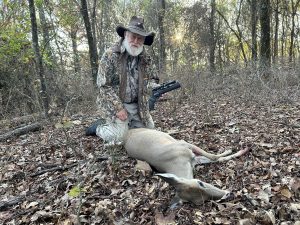
By hunt’s end I had sat in a blind watching a bear bait a total of 67 hours. Three early mornings I took off from bear hunting a couple of hours to help Dusty procure venison in the property’s high-fenced Estate Pasture, where “regular” Oklahoma’s game laws do not apply. Each of the mornings we hunted venison for the Choctaw Nation’s elderly and those families in need of food until 9 o’clock then I headed back to the bear bait. My final take, during my morning whitetail hunts included two management bucks and two “fully-grown” does. I shot each with my .454 Casull Taurus Raging Hunter double-action handgun, topped with a vintage 2.5-7×28 Thompson/Center Arms long-eye-relief scope, shooting Hornady’s Handgu Hunter 200-grain Monoflex ammo. All four were one-shot kills, shot at ranges from 45 to 80-yards. I could not have been more pleased with the handgun’s accuracy and the Hornady Monoflex bullet’s performance.
One of my bucks was a 3×3 without browtines. Like the two does they were broadside shots. My second buck was taken at 60-yards. Quartering to, I shot him in the onside shoulder. The bullet penetrated heavy bone, ribs, went through the heart and lungs, then through the liver ending up just under the skin on the opposite side, where it was all but protruding the skin. I measured the distance the bullet traveled in the deer’s body…just shy of 18-inches. The 200-grain Monoflex bullet was perfectly mushroomed. Impressive to say the least. The other three shot had been fully broadside and my bullet exited the body after doing considerable vital tissue damage.
Wish I could tell you how at the last moment I was able to take a bear, as I had done three times hunting Alaskan grizzlies, as well as several black bears. But that was not the case this time.
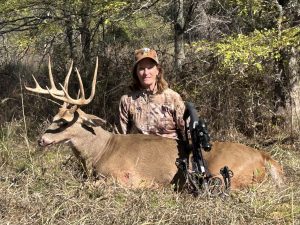
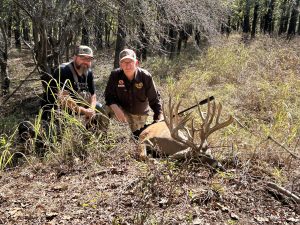
Was my bear hunt unsuccessful? No way! I had a great time logging 67-hours in a “bear blind”. And, I did harvest four whitetails, plus visited with great friends including Mark and Carol Little, fellow DSC members. Mark and Ms. Carol had bought a Choctaw Hunting Lodge free-range archery season whitetail hunt donated at a DSC (www.biggame.org) auction. Carol did herself proud taking a great 10-point. Mark, who had just returned from hunting Africa, found a whitetail in the Choctaw’s Estate area he really wanted. I got to be there with him when he squeezed the trigger during mid-day. I filmed his hunt for our “A Sportsman’s Life” show on CarbonTV.com.
Midday? This brings up an interesting topic. Recent research conducted says the moon has no affect whatsoever on deer movement. But interestingly the deer I watched were indeed affected by the moon, something I have watched and noticed during my many years of hunting and spending time in the deer woods, day and night and both as an observant hunter and professional wildlife biologist. I’ll simply leave the subject with deer where I hunt seem to be indeed affected by the moon, particularly when they feed and are “on their feet”. This particularly during the waning days of the new moon and post new moon when deer tended to be up feeding starting a half hour before moon set and continuing a half hour after moon set.
Now if I could just “figger out” black bears on the Choctaw…